









Best AI Analytics Platform in 2026:
What to Actually Look For.
Every BI and analytics vendor now claims to be an AI analytics platform. Tableau has Pulse, Einstein Discovery, and a new Agent product. Power BI has Copilot. ThoughtSpot was built around natural language search. Sigma has AI agents that can write back to your warehouse and trigger external systems. Databricks has an entire AI/BI product line. Snowflake has Cortex Analyst. The pitch decks are blurring together fast.
The honest answer to “which is the best AI analytics platform” is: it depends on what problem you’re actually trying to solve, what data environment you’re running, and how technically sophisticated your team is. But there are real differences that matter — and the marketing materials won’t tell you about them.
Here’s what we’ve seen across client implementations in pharma, restaurants, CPG, and private equity.
What “AI Analytics” Actually Means in 2026
Before comparing platforms, it helps to define what AI in analytics actually does — because different platforms have AI doing very different things.
AI for insight generation: The platform analyzes your data and surfaces insights you didn’t ask for — anomaly detection, root cause analysis, pace-to-goal alerts. Tableau Pulse and ThoughtSpot Sage operate in this category.
AI for natural language querying: Business users ask questions in plain English and the platform writes the query, runs it, and returns an answer. Snowflake Cortex Analyst, ThoughtSpot, and Power BI Copilot all do this. The quality varies enormously depending on how well your data is modeled.
AI for agentic workflows: AI agents don’t just answer questions — they take actions. Sigma Agents can write back to your warehouse, trigger webhooks, and interface with external systems like Salesforce. Tableau Agent can orchestrate multi-step analytical workflows. This is the frontier, and most organizations aren’t ready for it yet.
AI for data preparation: Dataiku and Databricks use ML to assist with feature engineering, data cleaning, and model training — AI helping with the work of building AI, essentially.
When evaluating platforms, the first question is which of these capabilities you actually need — not which platform has the most impressive demo.
The Platforms Worth Evaluating in 2026
Tableau (with Pulse + Einstein Discovery)
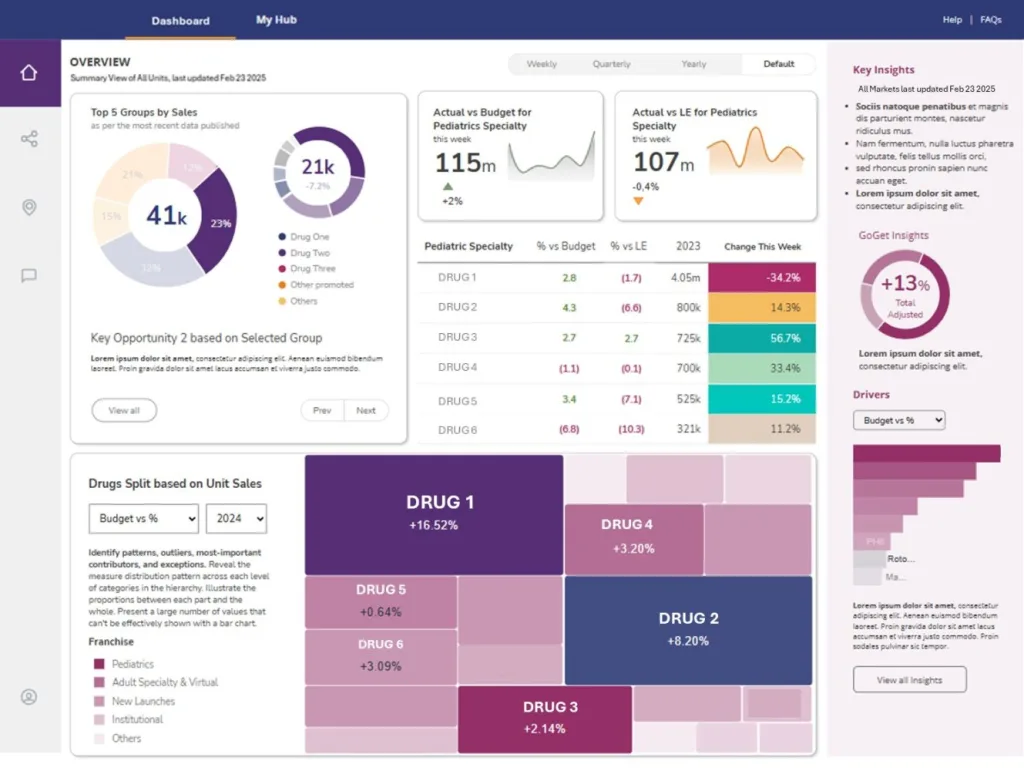
Tableau remains the visualization benchmark. Pulse brings AI-generated metric summaries, anomaly alerts, and pace-to-goal analysis directly into the workflow — it’s one of the more genuinely useful AI integrations we’ve seen because it delivers insights in the places where decisions happen rather than requiring users to go looking. Einstein Discovery adds out-of-the-box forecasting and driver analysis.
The limitation: Tableau’s semantic layer is thinner than Looker’s or Holistics’. AI-generated queries can be inconsistent when business logic lives in calculated fields scattered across workbooks rather than in a centralized model. The expanding product portfolio (Agent, Next, Pulse, Einstein Discovery) adds capability but also complexity.
Best for: Organizations with complex visualization needs and commercial analytics use cases — pharma, franchise, CPG — where the depth of what you can build matters more than the simplicity of the interface.
Power BI + Copilot
The AI implementation is most useful in Microsoft-standardized environments where Copilot is already in Teams, Excel, and Word. The natural language features work better when your data model is clean and well-documented — which is true of every NLP-based analytics tool, but worth emphasizing for Power BI where the DAX semantic model can become very complex very fast.
Best for: Microsoft-first organizations that need cost-effective reporting and want AI assistance integrated into tools their teams already use daily.
ThoughtSpot
Built from the ground up for search-based analytics — business users type questions, ThoughtSpot writes the query and returns results. When it works well (on clean, well-modeled warehouse data), it genuinely democratizes data access in a way that traditional BI tools don’t. The limitation is that it requires well-structured data and a governance discipline that many organizations haven’t built yet.
Best for: Organizations with clean, governed warehouse data and a primary goal of letting business users explore independently without analyst involvement.
Sigma Computing
Sigma Agents (released April 2026) are the most ambitious agentic analytics implementation we’ve seen — autonomous agents that can write back to Snowflake, trigger REST APIs, and interface with Salesforce, Jira, and Slack. The spreadsheet interface drives adoption in finance and ops teams. The limitation is governance: without a traditional semantic layer, metric consistency relies on careful worksheet management, which can create the same sprawl problem in a different interface.
Best for: Organizations fully committed to Snowflake with finance and ops users who want Excel-like exploration with AI assistance.
Snowflake Cortex
Cortex Analyst translates natural language into SQL and returns results. The advantage is that it lives inside your warehouse — no additional platform, no additional cost beyond compute. The limitation is that it still returns SQL results that the user needs to interpret; it doesn’t surface insights or detect anomalies proactively.
Best for: Organizations already on Snowflake that want to add conversational analytics without adding another platform and another vendor relationship.
Databricks AI/BI
Databricks’ analytics layer has improved significantly but it’s still strongest for organizations with significant data science and ML workloads rather than for teams whose primary need is business analytics and reporting. The AI capabilities are deep on the ML side — model training, feature engineering, MLflow — but less differentiated on the business intelligence side.
Best for: Organizations where ML and data science are the primary use case and BI is secondary.
The Framework for Choosing
Rather than asking “which platform has the best AI,” ask these four questions:
1. What specific decision does the AI need to help with? Detecting anomalies before they become problems is a different capability than letting business users ask ad hoc questions. Know which one you need.
2. How clean and governed is your data? Every AI analytics feature is only as good as the data it runs on. Natural language querying on a poorly modeled data warehouse produces wrong answers that look right. Before investing in AI features, invest in data quality.
3. What’s your team’s technical sophistication? Agentic workflows and ML-powered analytics require data engineering capability to implement and maintain. If you don’t have that capability in-house, the most powerful platform is also the most expensive to operate.
4. What are you already paying for? The best AI analytics platform for most organizations is the one they’re already licensed for, implemented correctly. Tableau Pulse on a well-governed Tableau environment delivers more value than ThoughtSpot on a chaotic data environment. Platform selection is usually the second problem, not the first.
The most common mistake: organizations evaluate AI analytics platforms before they’ve fixed their data layer. A sophisticated AI feature on unreliable, ungoverned data produces sophisticated-looking wrong answers. The sequence matters: data quality first, data model second, AI features third.
We’ve implemented analytics environments across Tableau, Snowflake, Databricks, Sigma, and ThoughtSpot. If you’re evaluating platforms and want an honest perspective based on what we’ve seen actually work in production, we’re happy to have that conversation.
Request a Conversation →