










AI Analytics Applications That Are
Actually Working in 2026.
There is a wide gap between AI analytics as it’s presented in conference keynotes and AI analytics as it actually operates in production environments. The keynote version is seamless, intelligent, and transformative. The production version is more nuanced — powerful in specific applications, fragile in others, and almost always dependent on a data foundation that the keynote never mentions.
We’re not here to be pessimistic about AI analytics. The applications that are working are genuinely valuable. But they’re working because of specific conditions — the right data quality, the right use case, the right implementation discipline — and understanding those conditions is the difference between a productive AI investment and an expensive experiment.
Here’s what we’re actually seeing deliver ROI across the industries we work in.
AI-Native Development Workflows (Claude Code, Cursor, Replit)
One of the quiet shifts happening alongside AI analytics is how teams are actually building and maintaining these systems.
Tools like Claude Code, Cursor, and Replit are changing the development lifecycle from “spec → build → debug” into a continuous loop of assisted engineering. Instead of waiting on long development cycles for analytics features, teams are now prototyping pipelines, SQL logic, and even lightweight data apps in hours instead of weeks.
In practice, this shows up in three ways: faster iteration on data models, quicker experimentation with analytics logic (especially anomaly detection and forecasting), and reduced friction between analysts and engineers when shipping production-ready code.
This doesn’t replace engineering discipline — it amplifies it. The same governance, testing, and data quality requirements still apply. The difference is speed. Teams that combine strong data foundations with AI-assisted development workflows are compressing delivery cycles without sacrificing structure.
What’s Working: Commercial Anomaly Detection
In pharma commercial teams, the most consistently valuable AI application we’ve implemented is anomaly detection on territory and prescriber data. When a rep’s top-decile prescriber suddenly drops off the prescribing pattern — without any obvious clinical or formulary explanation — the system flags it before the rep’s next sales cycle review, not after.
Before this capability, the rep might not notice until the quarterly territory review. By then, the prescriber has been prescribing a competitor’s product for three months. With anomaly detection running on live claims data, the field team gets a signal the week it happens and can act on it immediately.
This works because: the data is high quality and updated frequently, the anomaly definition is precise (not “something changed” but “this specific pattern deviated from baseline by more than X standard deviations”), and the output connects directly to an action the field team can take.
What’s Working: Automated Narrative Generation
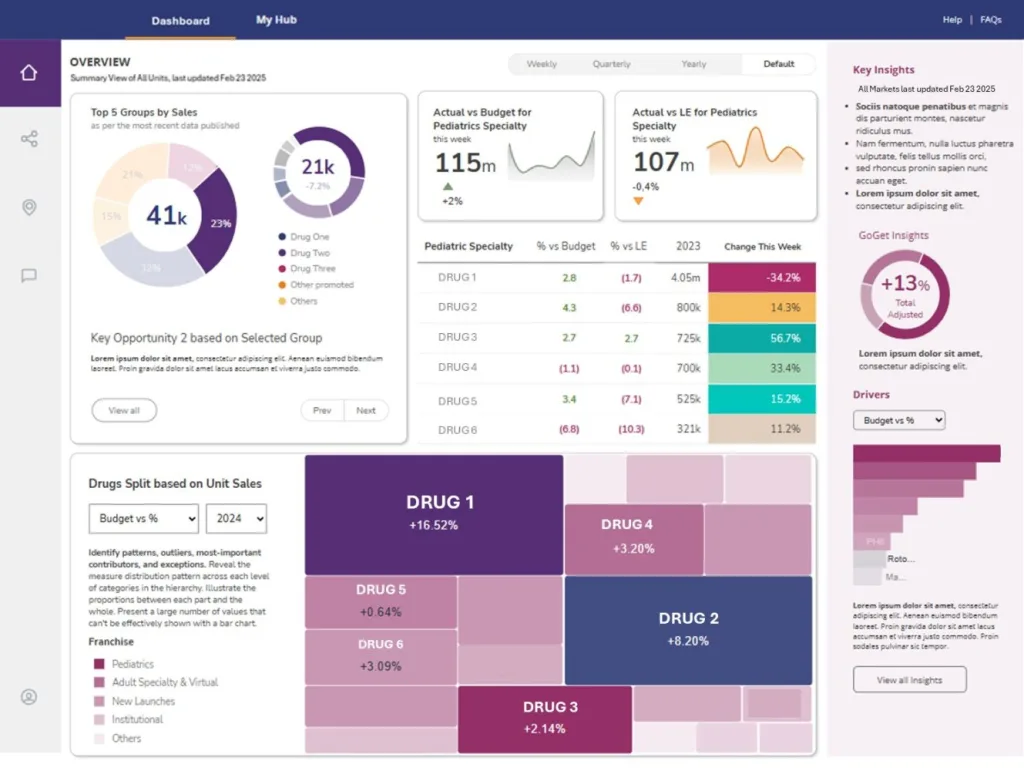
The QBR is one of the most expensive recurring processes in any commercial organization. A senior analytics person spends two to three days assembling data, building slides, and writing narrative. In most organizations, this happens every quarter across multiple business units.
AI-generated narrative — where the system writes a plain-English summary of what the data shows, what changed, and what drove the change — is working in production across several of our clients. It doesn’t replace the analyst’s judgment, but it eliminates the assembly work. The analyst reviews, refines, and adds context. The two-day process becomes a two-hour process.
This works because: the data model is clean and well-defined, the narrative templates are built around specific business questions rather than generic summaries, and the output is reviewed before it’s distributed rather than automated all the way to the end stakeholder.
What’s Working: Predictive Prioritization
In franchise and restaurant brands, predicting which locations are at risk of underperformance before it shows up in the lagging sales data is one of the highest-value AI applications we’ve seen. The model ingests leading indicators — labor metrics, order accuracy, guest satisfaction signals, local market conditions — and produces a weekly risk score for each location.
Operations teams use the risk score to prioritize their coaching and intervention resources. Locations that the model flags get attention before they miss their targets. Locations that the model scores as healthy get left alone unless they raise a flag. The result is a smarter allocation of limited operational resources.
This works because: the leading indicators are genuinely predictive (validated through backtesting before deployment), the model output is expressed in an actionable form (a prioritized list, not a probability score), and there’s a human decision in the loop (the operations team decides how to respond, not the model).
What’s Working: Natural Language Data Access for Executive Teams
ThoughtSpot, Tableau Pulse, and Snowflake Cortex Analyst have all matured enough that executive teams can get answers to standard business questions without analyst involvement. “What were the top five underperforming territories in Q2?” “Which product categories are growing faster than plan?” “Where are we losing market access coverage compared to last quarter?”
These questions used to require a ticket to the analytics team and a two-day turnaround. In organizations with clean, well-modeled data and natural language interfaces deployed thoughtfully, the executive asks the question and gets the answer in thirty seconds.
This works because: the data model is clean and the metrics are well-defined, the natural language interface is connected to a governed semantic layer rather than directly to raw data, and the expected questions are well-understood (the system performs best on questions the data was modeled to answer).
What’s Not Working
Being honest about where AI analytics fails is just as important as cataloging where it succeeds.
AI on dirty data. Every natural language querying tool, every anomaly detection system, every predictive model performs in direct proportion to the quality of the data it runs on. Organizations that deploy AI analytics on ungoverned, inconsistently defined, poorly modeled data get impressive-looking wrong answers. The sophistication of the AI interface does not compensate for data quality problems upstream.
AI as a substitute for data strategy. Some organizations have pursued AI analytics as a way to skip the foundational work of building a governed data environment. The hypothesis is that AI will make up for the lack of a semantic layer, the lack of metric governance, the lack of data quality. It doesn’t. The organizations that get the most from AI analytics are the ones that already had a strong data foundation.
Agentic AI without governance. AI agents that can take actions — write back to systems, trigger workflows, send communications — require governance infrastructure that most organizations haven’t built. Deploying agentic AI in an ungoverned environment is a fast path to automated errors at scale.
The Sequence That Works
The organizations that are getting the most value from AI analytics in 2026 followed a consistent sequence:
- Built a governed data foundation — clean data, consistent metrics, reliable pipelines
- Identified specific decisions that could be improved with better information
- Implemented AI capabilities targeted at those specific decisions
- Kept humans in the loop on consequential decisions until trust was established
- Expanded to additional use cases based on demonstrated value from the first
The organizations that are struggling with AI analytics skipped step one and two and went directly to step three — and are now trying to retrofit the foundation underneath an AI application that was built before the foundation existed.
If you’re evaluating AI analytics applications and want a grounded perspective on what’s actually working in your industry, we’re happy to share what we’ve seen in production.
Request a Conversation →